Measuring pressing in soccer
February 12, 2026 · 9 min read
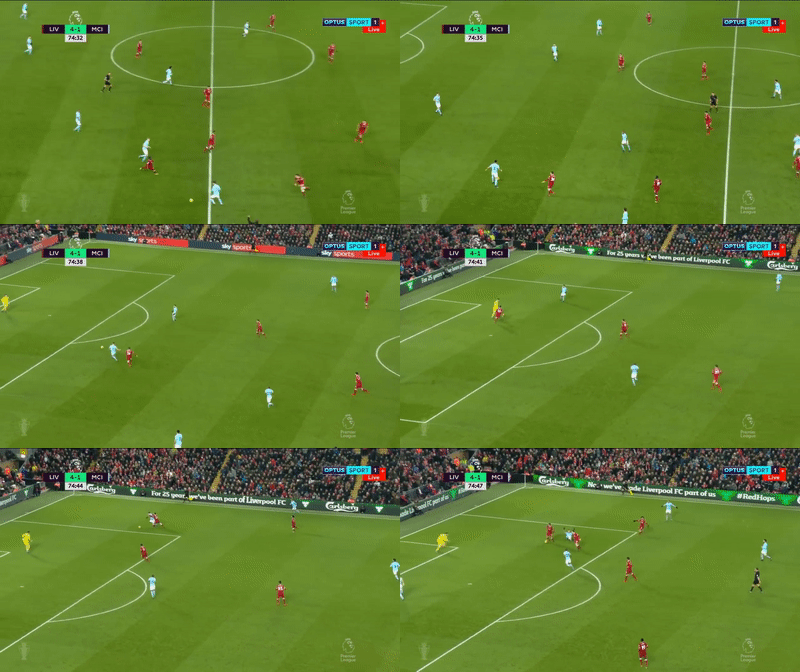
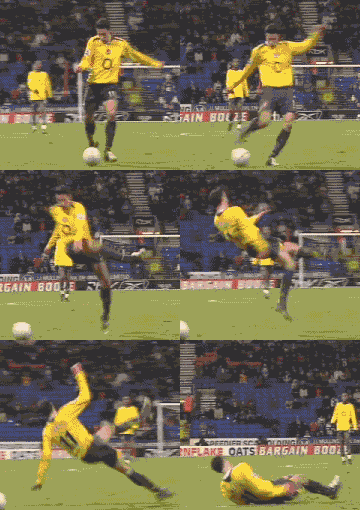
Pressing. If you're anything like me and mainly enjoy dribbling, passing, and all the fun things that lead to goals, you probably hated1 being yelled at to "pressure him!" or "force him inside!" or any of the other dozen ways coaches can colorfully explain they want you to sprint at the ball carrier. Who wants to waste energy playing defense when you could save it for your next encara-messi dribble through the entire team? Professional coaches do (or actually they want to tell their players to), that's who. And Andy Robertson (see above). Literally no other2 player I know enjoys pressing (don't let Thierry Henry3 fool you).
But coaches are onto something here. Pressing is incredibly important in the modern game, as more and more teams attempt to play out of the back. If you can press well, you prevent the other team from progressing the ball in a controlled manner, instead forcing them to boot the ball up the field and try to win duels against your (hopefully) big and tall centerbacks. Or, even better, you straight up just win the ball high up the field and quickly turn defense into attack. You don't need to be Pep Guardiola to realize that winning the ball high up the field = good for your chances of scoring.
The problem with current stats
While there exists a plethora of statistics for attacking (again that’s the fun part of the game), some of which are actually good4, hardly any exist for defending beyond rudimentary stats like tackles, blocks, or interceptions. All of these are horrible measures of actual defensive contribution because they focus on outcomes not process. Knowing a player intercepted the ball tells me nothing about their contribution. Did the attacker make a terrible pass? Did the intended target not step to receive the ball? Etc. etc. As Bill Walsh said:
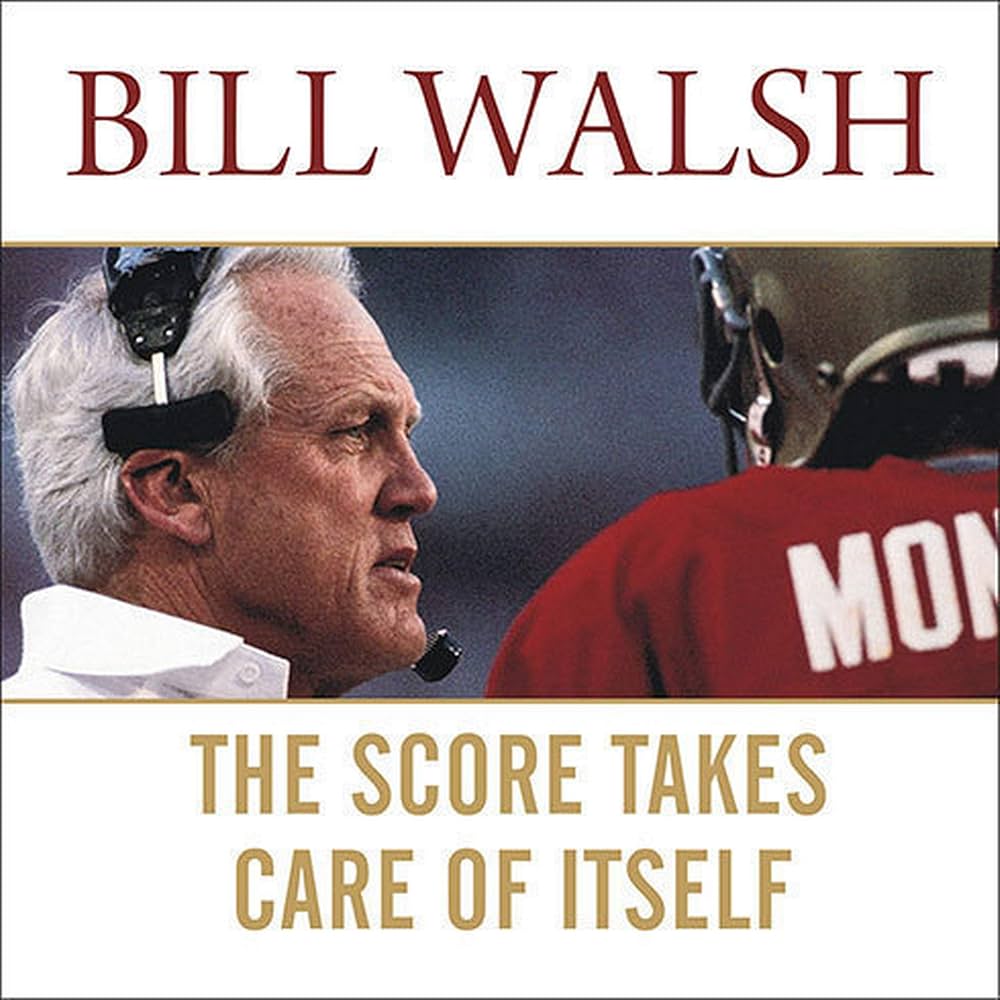
Meaning: stick to the right process and good outcomes will follow. So, being the nerd I am, I set out to try and quantify the "right process" for pressing, which is important because it helps coaches and scouts learn more about a player than simple stats like interceptions can reveal. A player who presses well will today will press well tomorrow, a player who had an interception today may or may not have one tomorrow.
What makes a good press?
I talked with some college coaches, players, and used common sense to come up with this list. I know it's short, but as Johan Cruyff so elegantly said, "Football is a simple game".
Good pressing comes down to two things mainly:
- Did you close down the ball carrier?
- Did you cut off immediate passing lanes?
The stats I mentioned above fail to capture any of this (there might be some correlation between closing down well and having lots of blocks, but it’s probably not very high).
My Metric
My metric is built almost entirely from tracking data.
To calculate my metric I first identify a pressing sequence, then I assign value to the presser. I define pressing sequences as situations when:
- A player receives the ball with no defender within 10 meters
- By the time they make their next action, a defender is within 5 meters
- At least 1 second passes in between these two events (basically a proxy for making sure the defender actually did some pressing)
To discover the pressing value, I use a weighted average of the two factors mentioned above that constitue a good press.
First, closing down the space. This is pretty easily measured by comparing the presser's velocity vector and the pressee’s (that’s not the word but whatever) position. Just using distance is not ideal because the orientation of the players matters. You want to press facing the attacker, not coming at them from behind. This is because you generally play the way you are facing (humans are not owls), so having someone behind you, while still annoying when trying to complete a pass, is much less annoying than having someone directly in front of you.
Second, I measure how well the presser cuts off passing options. Basically this comes down to comparing the passing options the player being pressed had before the press started, to the options they had once the press ended.
Measuring passing options is an interesting problem within itself, and I’ll write a separate blog about it in the near future, but for the sake of this article you can just assume I have a somewhat accurate model of it.
Some fun examples
That was a lot of words. Let’s use some pictures to hopefully make things a little clearer (I apologize for all the passing lines I realize they clutter things a bit).
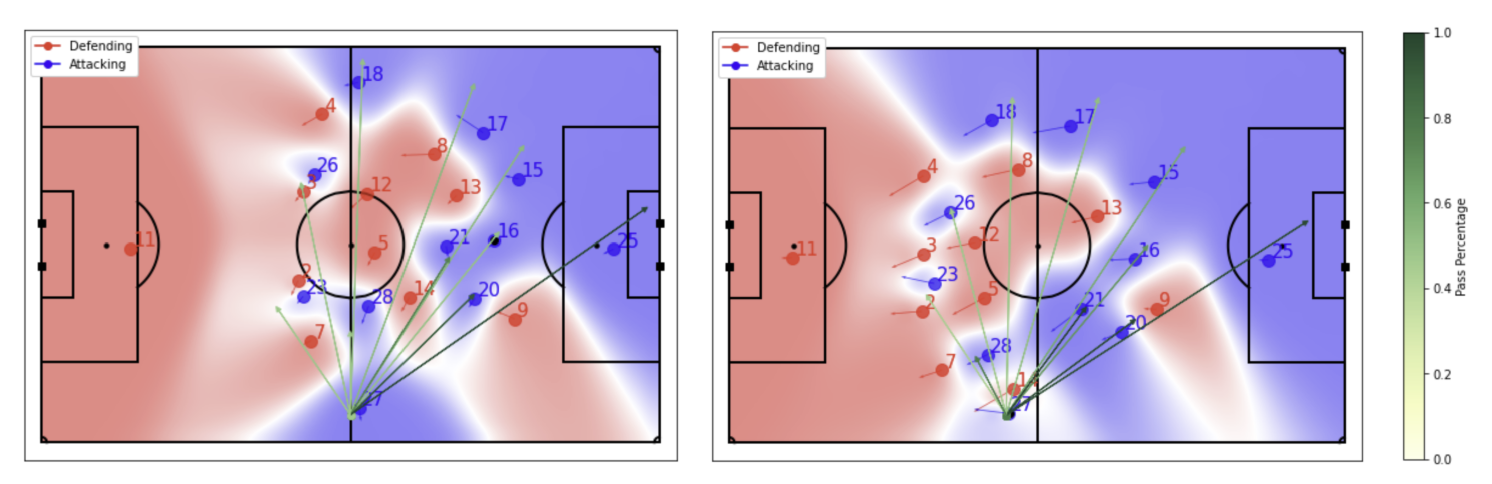
First, an example of a good press (Blue 27 has the ball). In the left image (the start of the press), there's a pretty open passing lane to Blue 28. In the right frame, the defender has curved their run and shut it down, making this a good press.
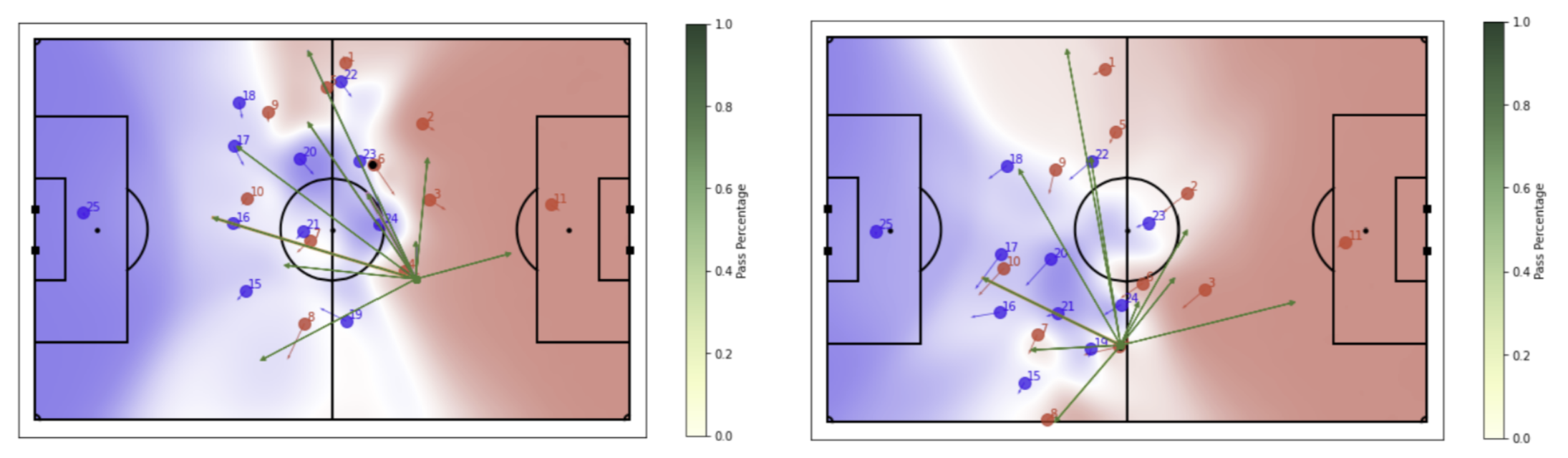
And now an example of a bad one. Blue 19 does a bad job of cutting off the forward passing lane to Red 8 since they kind of just run in a straight line. Instead they should have curved their run to force Red 4 to go back inside, where the Blue team was well situated.
Why the metric is useful
Take a look at this press, which ranked in the 7th percentile of my dataset.
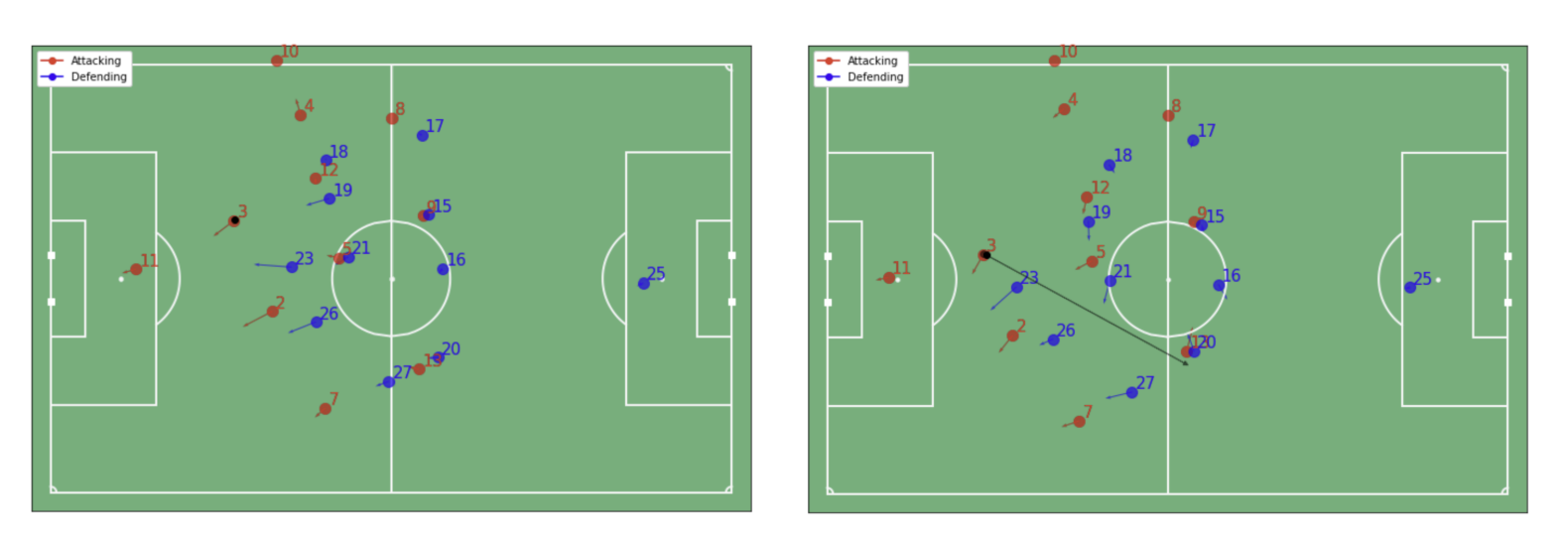
The defender does a poor job on both parts of what constitutes a successful press. He doesn’t close the ball down (look at his velocity vector), and doesn’t cut off any passing lanes. However, the attacker makes a terrible decision and attempts an absolutely audacious ball that predictably gets intercepted. As you can see, the outcome of an interception has little to do with a good press.
Now, the opposite. A press that ranked in the 90th percentile of my dataset.
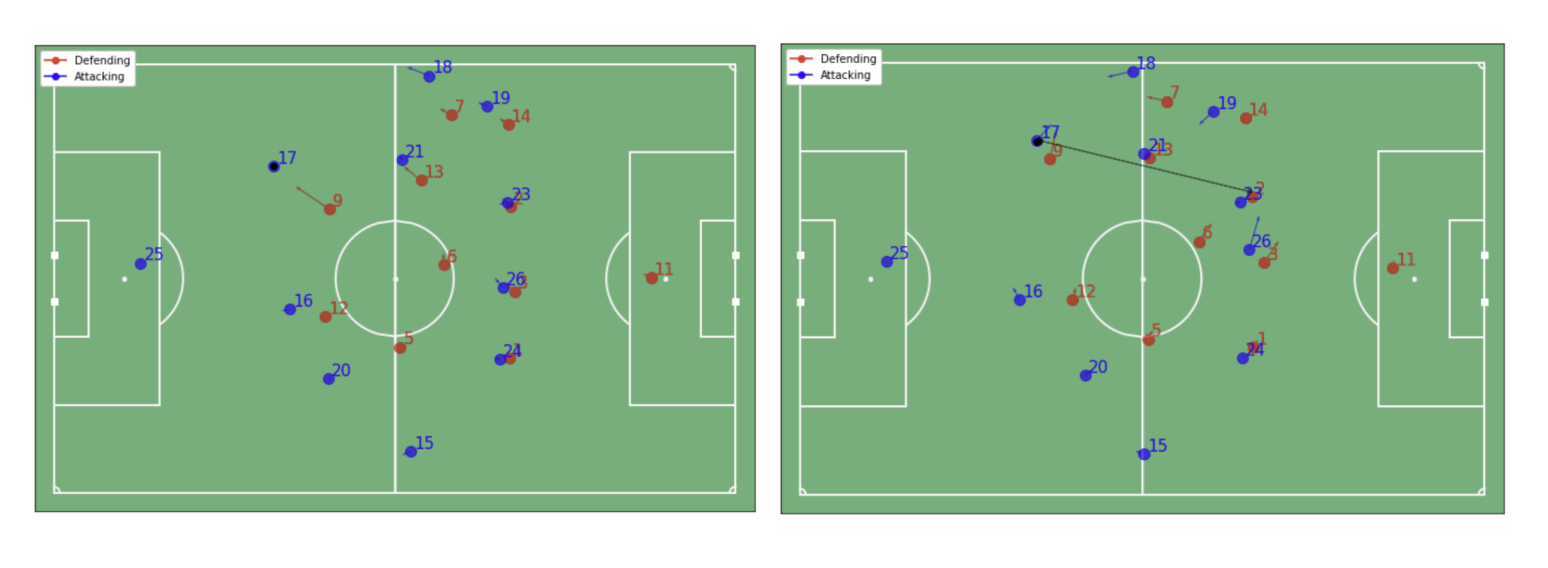
Red 9 does a great job curving their run to prevent the easy pass back to Blue 16, and does a fantastic job closing down the space. This forces Blue 17 into a tough situation and a bad pass that gets intercepted by Red 2. Again showing how the interception stat (which Red 2 would have received credit for) is a silly way to measure who was playing good defense.
Support for my metric
My metric correlates negatively with things you'd expect: possession length, how far up the field the opponent gets their next pass, and the highest point the possession reaches. In other words, better pressing (as measured by my metric) leads to worse outcomes for the attacking team. This is a generally good sanity check that it's capturing something of value.5
My metric isn't perfect by any means (see the next section), but I do believe it captures something that no existing metric does: did the defender actually do their job, regardless of what happened next?
Caveats
This is not a perfect metric by any stretch of the imagination.
One obvious issue is that it fails to measure anything about the offensive player, assigning all value of the pressing to the defensive player. But sometimes players being pressed just do stupid things - giving the defender credit for this is a little silly.
Another nit I have is that this just considers cases where the player being pressed makes a pass, not taking into account that he may just dribble around the defender (which would be very bad pressing indeed).
Also, as Michael Edwards would remind me, the metric doesn’t really take game state/context into account. For instance, late in the game, a team that is winning might invite pressure just to boot the ball up the field (or maybe, if they're Mikel Arteta’s Arsenal - that was their game plan all along!). These variables are hard to pull out of all the noise though, and I think over long horizons (one season or more of data roughly) it shouldn’t matter, since each presser should in theory be facing a similar distribution of game state + opponent strategies.
Next Steps
Some fun next steps (off the top of my head, I'm sure there's plenty more to go off of) might be:
- Calculating a metric adjusted for offensive player decision making/skill
- Calculating team based pressing metrics (i.e. measure how well a team constricts passing options, not just individual players)
- Compare players in the same system, since pressing in a team that parks the bus v.s. a team that gegenpresses is very different
1I'd like to apologize to my youth soccer coach Carlos here. He was right, I should have played more defense
2Raphinha as well. And a few others. But that doesn't fit the narrative of my article so I'm going to pretend these players don't exist
3I am sorry for posting a tiktok this was just the first link on google and I'm lazy
4I'll write some thoughts on some of these "advanced" attacking stats some day, stay tuned
5I don't have a lot of data so I'd take this with a grain of salt, but I believe in my metric and if data wasn't so expensive I'd test it on more and get some statistically significant results back